


Quick Links
A structured BGP practice system designed to make the protocol familiar before real traffic, real customers, and real pressure turn it into your problem.
There’s no point pretending BGP is easy. It isn’t.
And that would be fine if BGP only lived inside books, videos, and certification blueprints. But sooner or later, BGP stops being a chapter you studied.
It becomes the session that won’t come up. The prefix that should be advertised but is missing. The route that appears in the BGP table but never reaches the routing table.
It’s the path that changes after a policy update. The aggregate that looks correct while traffic to one of its component networks disappears. The migration where one side is ready for the new ASN and the other side still expects the old one.
And when that happens, there’s usually more attached to the problem than a lab score. There’s traffic moving through that network, users depending on it, and maybe customers waiting. Someone may be asking how long it’ll take while you’re still trying to decide where to look.
That is the worst time to begin learning how BGP behaves.
You may already know the commands. You may know what Local Preference does, what AS_PATH means, and how to explain the difference between iBGP and eBGP.
But when the expected route isn’t there, the definition doesn’t tell you which table to inspect next. When a reflected route exists but traffic still fails, memorizing route-reflector-client doesn’t explain the inaccessible next hop. And when ebgp-multihop 1 looks perfectly reasonable and the session remains down, knowing that BGP uses TCP port 179 doesn’t expose the connected check IOS is still enforcing.
That gap matters.
Because BGP isn’t a skill you want to meet for the first time during an incident. You want to have seen the behavior before. You want the strange output to look familiar, know which assumption to verify, and have a safe place to be wrong before the network makes the mistake expensive.
Familiar enough that a session stuck in Idle doesn’t send you searching randomly through the configuration. Familiar enough that a route inside show ip bgp doesn’t automatically convince you that traffic can use it. Familiar enough that when a summary, filter, Route Reflector, multipath policy, or migration produces an unexpected result, you have a starting point.
That familiarity doesn’t come from another explanation. It comes from repeated contact with the behavior itself.
You build the topology, make a prediction, and configure the policy. Then you inspect the BGP table, routing table, neighbor state, UPDATE message, debug output, or packet capture. You compare what happened with what you expected, change one detail, and watch the behavior change.
That’s how BGP stops feeling like a collection of unrelated commands and starts behaving like a system you recognize.
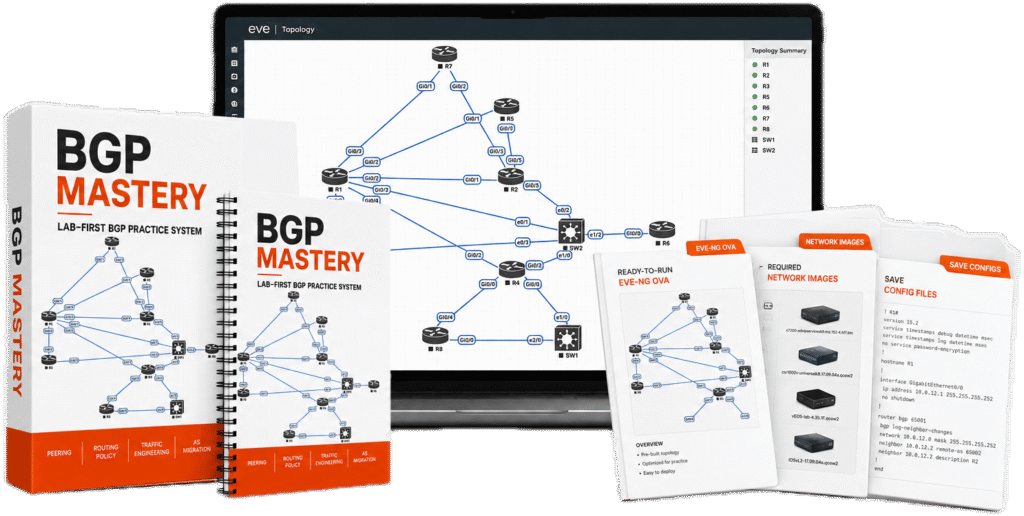
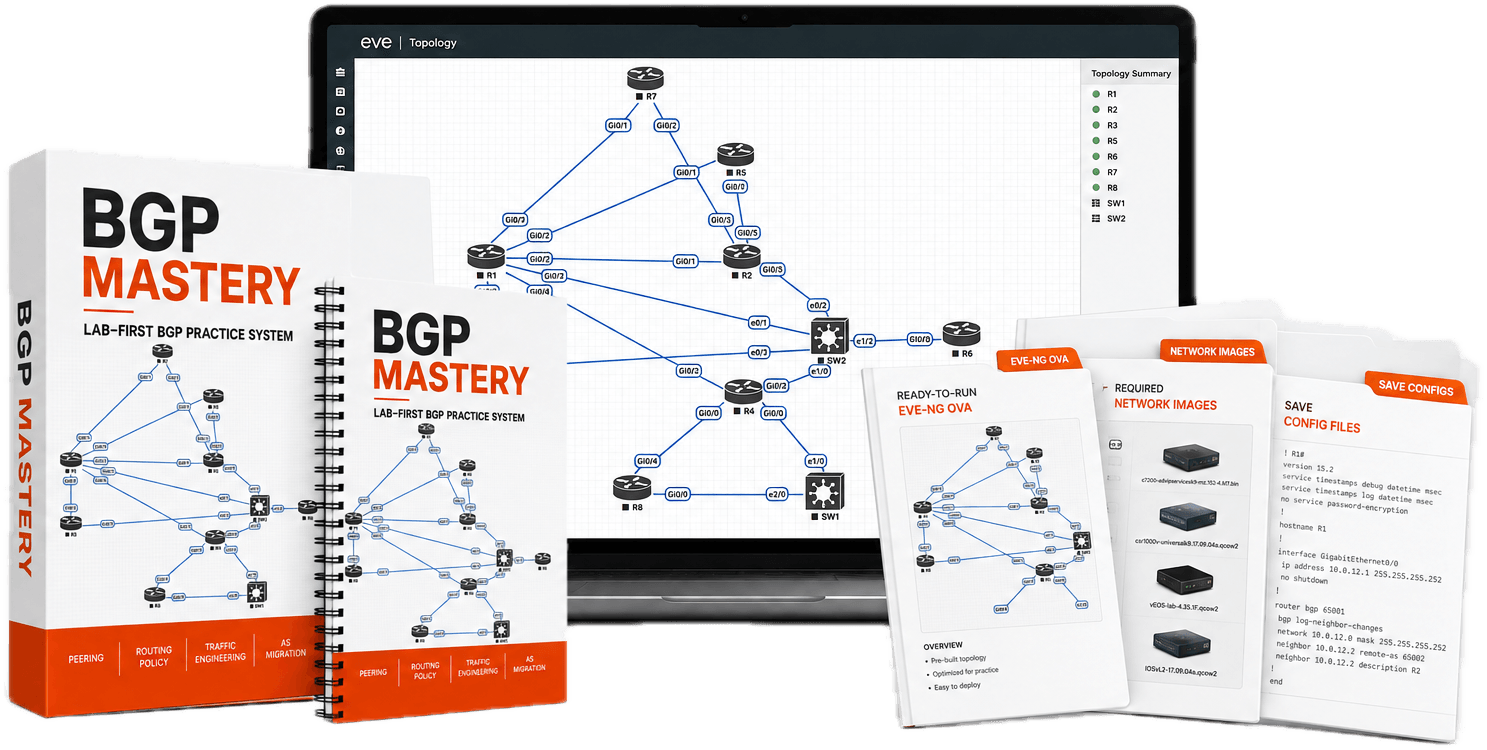
BGP Mastery is a Lab-First practice system built around 10 detailed BGP workbooks and a ready-to-run EVE-NG environment. Each workbook gives you a network, a specific objective, the configuration process, the verification points, the expected behavior, and the reasoning behind the result.
But the workbook isn’t there to do the thinking for you. It gives you a path through the scenario the first time. Then you run it again.
You open the Blank Topology and rebuild the scenario without following each step. When something doesn’t match, you compare your work with the verified configurations. Then you change variables, break the behavior deliberately, reset the lab, and run it again.
The OVA removes the setup work. The practice remains.
Because the setup isn’t where BGP skill is built. The skill is built while you’re deciding, configuring, inspecting, troubleshooting, correcting, and repeating.
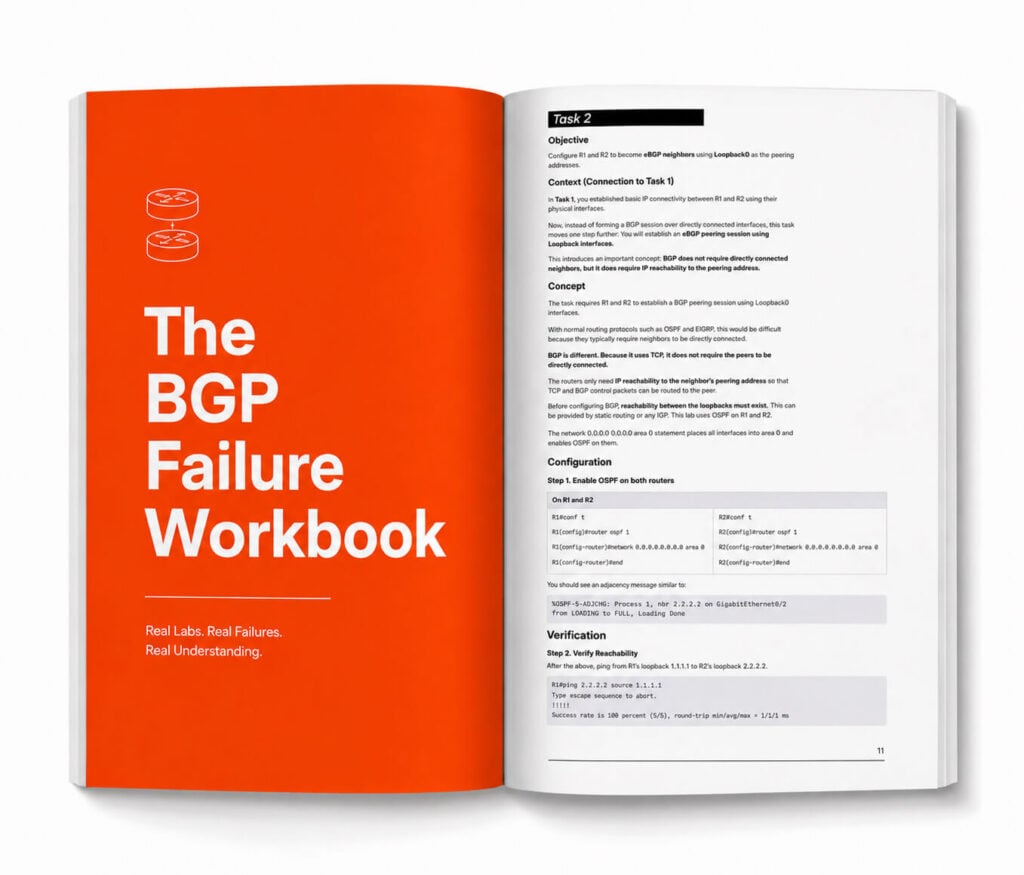
Work through TCP session establishment, eBGP loopback peering, connected checks, TTL behavior, GTSM, PPPoE, and MPLS-based alternatives.
Build iBGP and eBGP relationships using full mesh, peer groups, templates, authentication, loopback sources, and next-hop corrections. Then inspect MED and third-party next-hop behavior in actual UPDATEs.
Replace full-mesh iBGP with Route Reflectors, troubleshoot reflected routes that remain unreachable, add redundancy, and inspect the attributes that prevent reflection loops.
Build a multi-sub-AS confederation, observe how paths change inside and outside the confederation, and verify the policy attributes that cross confed-eBGP boundaries.
Control the interaction between BGP and another routing protocol, inspect RIB failure, advertise a backup only when a condition changes, and inject a route based on evidence in the BGP table.
Create and verify aggregates, suppress or reveal selected component routes, inspect AGGREGATOR, ATOMIC_AGGREGATE, and AS_SET, and expose the black-hole risk created by careless manual summaries.
Build policies with prefix lists, route maps, filter lists, AS-PATH regular expressions, maximum-prefix controls, AS-path limits, and ORF. Then verify where a route exists at each stage of BGP processing.
Configure external and internal multipath, learn why apparently equal paths do not always qualify, and build unequal-cost iBGP load sharing based on external link bandwidth.
Walk through several private and public ASN combinations until the behavior of remove-private-as and its all option becomes visible instead of theoretical.
Move a router from one ASN to another while maintaining peering compatibility, then verify exactly how local-as , no-prepend , replace-as , and dual-as change OPEN and UPDATE messages.
Here’s how to use BGP Mastery. First, complete the workbook from beginning to end. Do the configuration yourself, run every verification command, and read the explanation after you’ve inspected the behavior. Don’t rush past a result you can’t explain.
Second, run the same scenario again. This time, rely less on the workbook. Try to remember the sequence, the checks, and the reason for each decision.
Third, open the Blank Topology and rebuild the scenario without step-by-step guidance. When your result doesn’t match, compare your configuration with the verified files. Find the difference before copying the answer.
Then change a variable. Remove a route, change an ASN, alter the TTL requirement, modify the filter, withdraw a component prefix, or break the session deliberately. Explain why the new behavior appeared.
That’s where familiarity begins. Not after one pass, but after enough correct repetitions that the output starts telling you what to check next.
Good. Then the opening explanations will move quickly.
The real test begins when the route is present but unusable, when a command that looks correct produces a different result, or when two tables tell different stories. It also begins when a policy works for one path and fails for another because one ASN is public, another is private, or one attribute has been inherited by an aggregate.
Understanding the definition helps. The workbooks ask you to prove that understanding against actual behavior.
Yes. You could create every topology, prepare every router, write every task, predict every result, collect the verification output, test the edge cases, build the blank versions, and document every explanation yourself.
That work would teach you a great deal. It would also delay the moment you begin practicing the behaviors the system has already organized for you.
BGP Mastery removes that preparation work. It does not remove the engineering work. You still have to configure, verify, troubleshoot, reset, and repeat.
One payment. Lifetime access.
You’re not paying for another pile of BGP information. You’re paying for a structured place to confront the behavior before production makes the confrontation unavoidable.
Use BGP Mastery for the next 30 days. Run the labs, inspect the behavior, break something, and fix it.
If you decide the system isn’t right for you, send Dynamips a message within the guarantee period and request a refund under the current 30-day guarantee. The guarantee gives you time to judge the system by using it.
You can wait until a real session, real migration, real route policy, or real traffic path puts the problem in front of you. Or you can meet the behavior now, inside a lab you can reset, with evidence you can inspect, and with enough repetition to make the next decision easier to see.
Run the lab. Break it. Then fix it.
One payment. Lifetime access.
30-Day "Practice Risk-Free" Money-Back Guarantee
(If you don’t love it, I’ll refund every cent — no questions asked)

— Founder, Dynamips®
P.S. The first time you see no route to peer should not be while somebody is waiting for production traffic to recover. BGP Mastery gives you a place to encounter that message, trace the real cause, fix it, reset the topology, and make the behavior familiar before you need it.
P.P.S. You have 30 days to work through the system and decide whether this is the kind of BGP practice you were looking for. If it isn’t, request a refund under the current guarantee.
We usually respond within 12 hours.
YOUR DETAILS · THEN PAYMENT
Enter your name and email, then continue to payment.
Enterprise Troubleshooting Labs · $39
30 labs · 42 PDF workbooks and guides
One-time payment · Lifetime access
No payment is taken on this form.
Please sign in or sign up below.
Please enter the 6 digit code we sent to .
Add a few details so we can personalize your experience.
Sign in with your email and password.
You can continue on this page.
By signing in, you agree to our Terms and Privacy Policy.
