



Table of contents
This is a must Read…
In 1999, I walked into an office to pick up a file.
I was working for a small company at the time, doing whatever needed to be done. Running errands. Delivering documents. Helping wherever I could. Like most people at that stage of life, I was simply trying to earn an income and become independent.
When I entered the room, something immediately caught my attention.
Not the person.
The computer sitting beside him.
The case was enormous. At least three times larger than any computer I had seen before.
I pointed at it and asked a simple question.
“Why is that computer so big?”
He looked at me and replied:
“That’s a server.”
That was it.
Just one sentence.
But I still remember that moment.
Back then, I had never seen a server before. Rack-mounted servers weren’t sitting in every office the way they are today. Most computers looked exactly the same to me. For the first time, I realized there was an entire world behind the computers I used every day. A world I knew almost nothing about.
Not long after, someone gave me a piece of advice that would shape the beginning of my career.
I told him I wanted to learn networking.
Instead of pointing me toward networking, he suggested I start somewhere else.
He told me to learn hardware first.
His reasoning was simple.
“If you don’t understand how a PC works, you’ll struggle to understand how a server works. And if you don’t understand the server, you’ll struggle to understand the network built around it.”
At the time, I wasn’t convinced.
Looking back, it was one of the best pieces of advice I ever received.
So I followed it.
I spent months learning hardware. Then I spent even more time building PCs, replacing components, troubleshooting failures, and solving problems. What felt like a detour at the time eventually became a foundation.
In 2001, I officially entered the networking industry.
I had no idea where that decision would eventually lead. At the time, I was simply trying to learn the technology, understand the tools, and figure out how networks actually worked.
What I couldn’t see then was that those early experiences would become the beginning of a career that would span more than two decades.
Today, more than twenty-five years have passed since those early days.
And twenty-five years is a long time.
Long enough to watch technologies come and go, certifications evolve, and entire networking careers take completely different paths.
During those twenty-five years I’ve worked in ISPs, data centers, enterprise environments, and training. I’ve interviewed engineers, hired engineers, trained engineers, and worked alongside engineers.
And over all those years, I’ve noticed something strange.
Over the years, I noticed something that didn’t make sense.
Some engineers seemed to move forward almost effortlessly.
Others stayed in exactly the same place.
The more I studied them, the more I realized their success had very little to do with intelligence, memory, or natural talent. In many cases, they weren’t the smartest people in the room at all.
Meanwhile, other engineers stayed stuck for years. They bought another course, watched another video series, downloaded another workbook, created another study plan, and somehow ended up exactly where they started.
A few years ago, I started paying closer attention.
I wanted to understand what separated the engineers who progressed from the engineers who stayed trapped.
At first, I assumed it was knowledge.
Maybe the successful engineers simply knew more.
But the more I observed, the less that explanation made sense.
Some of the strongest engineers I knew actually knew less theory than the people who remained stuck.
What separated the two groups wasn’t knowledge.
It was behavior.
Over time I noticed the same patterns appearing again and again. The same mistakes. The same habits. The same traps.
It didn’t seem to matter whether the engineer lived in a different country, worked for a different company, or had a completely different level of experience.
The details changed.
The underlying patterns didn’t.
I kept seeing the same mistakes repeated over and over again.
What surprised me most wasn’t how common these mistakes were.
After all, common mistakes exist in every profession.
What surprised me was how subtle they were.
Most engineers don’t even realize they’re making them.
In fact, while reading this guide, there’s a good chance you’ll recognize yourself in at least one of them.
Maybe even more.
The good news is that none of these mistakes have anything to do with talent.
They aren’t permanent flaws, and they aren’t signs that you’re incapable of becoming a great engineer.
They’re simply behaviors.
And because they’re behaviors, they can be changed.
Once they’re corrected, progress becomes dramatically easier.
The first mistake is probably the most common one I see in networking today.
What’s interesting is that it rarely looks like a mistake.
Most people think it’s progress.
It isn’t.
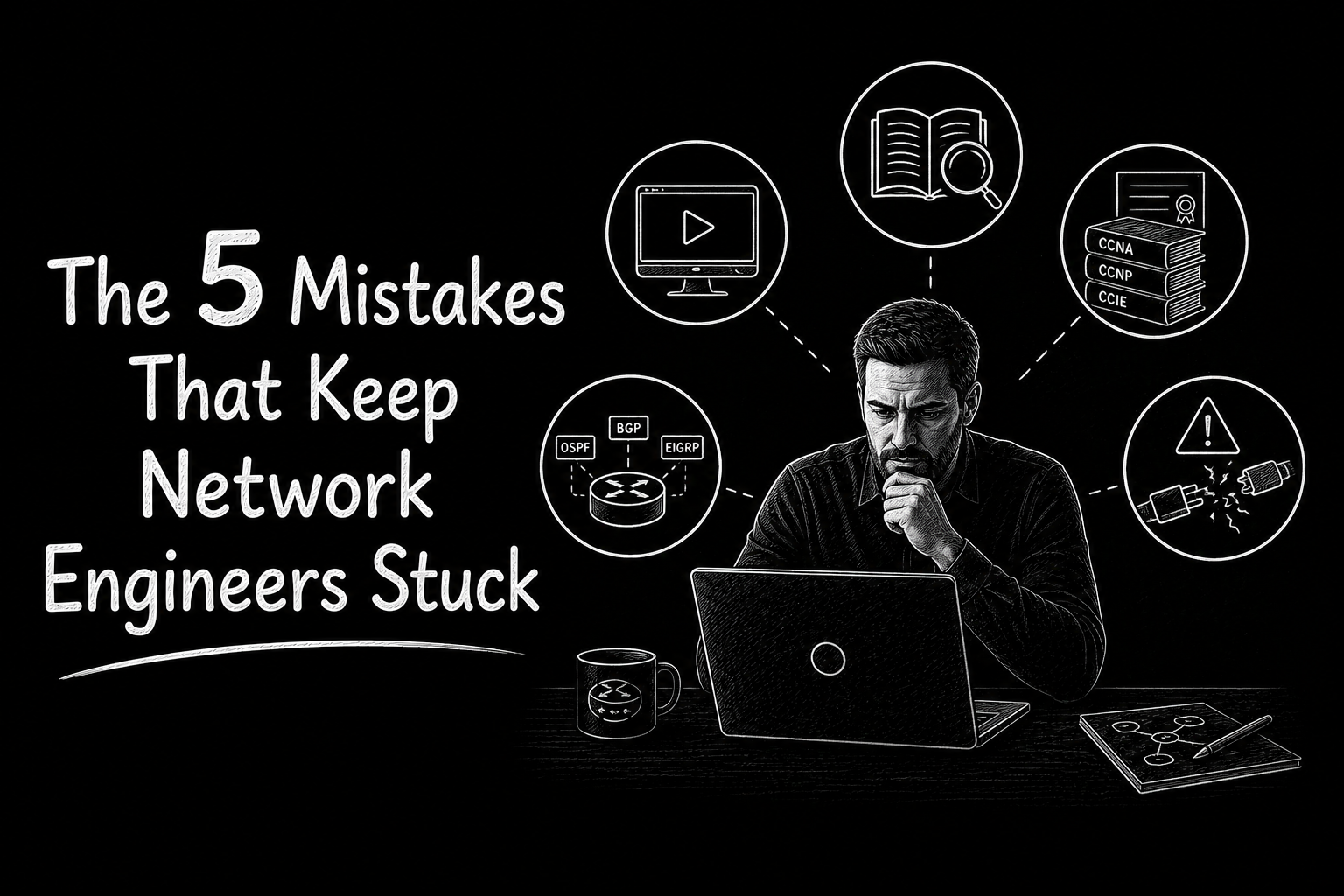
Mistake #1 – Watching Instead Of Building
A few years ago, I noticed something interesting.
The students who struggled the most weren’t the students who studied the least. In many cases, they were studying more than everyone else. They watched videos during lunch breaks. They watched videos after work. They watched videos before going to bed.
Some of them had watched hundreds of hours of networking training. CCNA. CCNP. OSPF. BGP. Switching. Security. Automation. You name it. They were consuming information every single day.
Yet when I sat them in front of a router and asked them to configure something simple, many of them froze. Not because they were lazy. Not because they weren’t trying. Because watching had quietly replaced building.
And the difference between those two things is much bigger than most people realize.
Watching networking feels productive. Building networking feels uncomfortable.
When you’re watching a video, everything works. The instructor already knows the outcome. The topology is already built. The commands are already correct. The troubleshooting has already been solved. The lesson flows smoothly from beginning to end.
You sit there thinking:
“That makes sense.”
“I understand that.”
“I could do that.”
Then you open your own lab and suddenly everything changes.
The neighbor relationship doesn’t come up. The route table doesn’t look right. The ping fails. The topology behaves differently than expected. And now there’s nobody to tell you what comes next.
This is where real learning begins.
Unfortunately, this is also where most people stop.
Because building exposes something that watching hides.
Confusion.
And confusion feels uncomfortable.
So instead of staying with the problem, many engineers go back to another video. Another course. Another explanation. Another instructor. Another playlist.
What they actually need is another lab.
Years ago, when I was teaching networking classes, I saw this happen constantly. I would explain a topic. Everyone nodded. Everything seemed clear.
Then I would say:
“Okay. Your turn.”
The room would become very quiet.
Not because the students were incapable.
Because understanding and building are two completely different skills.
One exists in your head.
The other exists in your hands.
And networking is ultimately a hands-on profession.
Nobody pays a network engineer because they can recognize the name of a protocol. Nobody hires an engineer because they watched a twenty-hour course. The market rewards engineers who can build, verify, troubleshoot, recover, and repeat.
That’s why some engineers make surprisingly fast progress. They spend less time consuming and more time constructing.
They don’t watch ten OSPF lessons. They build ten OSPF topologies.
They don’t study EtherChannel for a week. They build EtherChannel until it becomes boring.
They don’t memorize BGP path selection. They force BGP to make routing decisions and then observe what happens.
Building creates questions. Questions create investigation. Investigation creates understanding. And understanding creates confidence.
Watching rarely creates any of those things.
If you remember only one sentence from this entire guide, make it this one:
Networking is not a spectator sport.
The engineers who move forward are rarely the ones who watch the most.
They’re usually the ones who build the most.
Before moving on to the next mistake, ask yourself one honest question:
During the last thirty days…
How many hours did you spend watching networking…
And how many hours did you spend building it?
Mistake #2 – Reading Instead Of Verifying
A few years ago, I asked a student a simple question.
“What determines the DR on a broadcast network?”
The answer came back immediately.
Highest priority.
Then highest Router ID.
Perfect.
So I asked another question.
“How many DR elections have you actually watched?”
Silence.
The student knew the answer. But had never seen it happen.
And that’s where a lot of networking careers quietly get stuck.
Engineers spend years learning descriptions of protocols without ever observing the protocols themselves. They know what OSPF is supposed to do. They know what BGP is supposed to do. They know what STP is supposed to do. But they rarely stop and watch what those protocols are actually doing.
The networking industry has an obsession with explanations. Everywhere you look, someone is explaining something. More videos. More books. More diagrams. More slides. More notes. More theory.
And while theory is important, it creates a dangerous illusion. You start believing that understanding a protocol description is the same thing as understanding protocol behavior.
It isn’t.
Not even close.
Let me give you an example.
Suppose I ask two engineers about OSPF.
The first engineer tells me:
“OSPF elects a DR and BDR on broadcast networks to reduce adjacency requirements.”
Technically correct.
The second engineer tells me:
“I changed the priority on three routers yesterday and watched the election happen. Then I reset the adjacency and captured the LSAs before and after the election.”
Which engineer would you trust during an outage?
The difference isn’t knowledge.
The difference is observation.
One engineer learned the explanation. The other engineer observed the behavior.
And behavior is what matters in production networks.
When a routing protocol fails, the protocol doesn’t care what page of the certification guide you memorized. It only cares about what it’s doing right now. What routes it’s installing. What packets it’s exchanging. What decisions it’s making. What state it’s currently in.
That’s why some engineers become exceptional troubleshooters while others remain trapped in theory.
Exceptional troubleshooters spend an enormous amount of time observing. They verify everything. They don’t trust assumptions. They don’t trust memory. They don’t trust documentation.
They look.
They check.
They confirm.
When OSPF forms an adjacency, they don’t stop at:
“Great. Neighbor is up.”
They ask:
What state transitions occurred?
What LSAs were exchanged?
What changed in the routing table?
What changed in the topology database?
How long did convergence take?
Why did this router become the DR?
What happens if I shut down this link?
What happens if I change this cost?
What happens if I introduce another path?
This curiosity is what separates operators from observers.
Years ago, while working on production networks, I learned a lesson that has stayed with me ever since.
The network is always telling you exactly what’s happening.
The problem is that most engineers aren’t looking.
They’re trying to remember what they read instead of observing what the network is showing them.
And unfortunately, memory becomes unreliable under pressure.
Observation does not.
That’s why whenever I build a lab, my first goal is rarely configuration. My first goal is visibility. I want to see what the protocol is doing. I want to see why it’s making decisions. I want to see what changes when something breaks.
Because once you can observe behavior, troubleshooting becomes dramatically easier.
Most engineers think they need more commands. Most engineers think they need another course. Most engineers think they need another explanation.
Often they don’t.
They need to spend more time watching the network behave.
Not reading about behavior.
Not hearing about behavior.
Actually observing behavior.
Before moving on to the next mistake, ask yourself another honest question:
The last time you built an OSPF lab…
Did you spend more time configuring it…
Or more time observing it?
Mistake #3 – Collecting Courses Instead Of Repetitions
Not long ago, I asked a network engineer what resources he was using for CCNA.
The list kept going.
A video course. Another video course. A YouTube channel. A certification guide. A workbook. A lab platform. A second workbook. A study group. A Discord community. A few websites. Several PDFs. And probably a dozen browser tabs he planned to come back to later.
On paper, it looked impressive. He had access to more networking information than most engineers had twenty years ago.
Yet he was struggling.
Not because he lacked resources.
Because he had too many.
This is one of the biggest traps in modern learning.
Years ago, finding good networking training was difficult. Today, avoiding networking training is difficult. Every week there’s another course. Another instructor. Another platform. Another certification roadmap. Another “ultimate guide.” Another “complete masterclass.”
And because all of these resources promise progress, it’s easy to believe the next one might finally be the missing piece.
So people keep collecting.
Collecting feels productive. Buying feels productive. Downloading feels productive. Organizing feels productive.
But none of those activities create skill.
Skill comes from repetition.
And repetition is boring.
That’s why so few people do it.
Think about the best musicians. The best athletes. The best surgeons. The best pilots.
None of them became exceptional because they consumed more information than everyone else. They became exceptional because they repeated fundamental actions thousands of times.
Networking is no different.
The engineers who progress fastest are often doing something surprisingly simple.
They repeat.
Over and over again.
Instead of building fifty different OSPF labs once, they build the same OSPF lab ten times. Instead of learning ten routing protocols at the same time, they become dangerous with one. Instead of chasing variety, they chase familiarity.
And familiarity creates speed.
Years ago, I noticed something interesting while teaching.
The strongest students weren’t always the students who learned concepts fastest. Often they were the students who repeated labs most aggressively.
They would rebuild the same topology. Run through the same verification commands. Break the same scenario. Fix the same failure.
Again.
And again.
And again.
At first it looked inefficient.
Why repeat something you already know?
Then something remarkable happened.
While everyone else was trying to remember commands, these students stopped thinking about commands entirely. The commands became automatic. Their attention shifted to behavior, troubleshooting, decision making, and understanding.
That’s where real progress begins.
Because certifications don’t reward repetition.
The market does.
Nobody in a job interview is impressed because you’ve watched five different OSPF courses. Nobody cares how many PDFs you’ve downloaded. Nobody cares how many bookmarks you’ve saved.
What matters is whether you can solve a problem.
And solving problems comes from familiarity.
Familiarity comes from repetition.
I learned this lesson myself many years ago.
When I was getting started, I thought progress meant constantly moving forward. The next topic. The next chapter. The next protocol. The next technology. Like many engineers, I assumed that moving quickly through new material was a sign of progress.
What I eventually discovered was that mastery often looks very different.
Mastery often looks like moving backward.
It looks like revisiting a topic you think you already understand. Repeating a lab you’ve already completed. Rebuilding a topology you’ve already configured. Reviewing concepts you’ve already studied. Running the same scenario one more time, not because you failed the first time, but because you’re trying to move beyond familiarity and into instinct.
The engineers who stay stuck are usually looking for something new. The engineers who move forward are usually extracting more value from something old.
One group is searching for information.
The other is building capability.
And capability always wins.
Mistake #4 – Studying Protocols Instead Of Behaviors
If there’s one mistake I’ve seen more than any other during the last twenty-five years, it’s this one.
Engineers study protocols.
But they never study protocol behavior.
At first, those two things sound identical.
They aren’t.
Not even close.
Most engineers can tell you what OSPF is. Far fewer can tell you how OSPF behaves when the network starts changing underneath it. Most engineers can explain what BGP attributes are. Far fewer have watched BGP choose one path, reject another, and then completely change its decision after a single attribute modification. Most engineers can define Spanning Tree. Far fewer have spent hours observing what actually happens when a root bridge disappears in the middle of the day.
This distinction matters more than most people realize.
Because networks don’t operate in definitions.
They operate in behavior.
Nobody gets called at 2:00 AM because they forgot the definition of OSPF. Nobody gets paged because they can’t remember the textbook description of a Designated Router. Nobody loses connectivity because someone failed to memorize a certification guide.
Problems happen because protocols are behaving in ways that engineers don’t expect.
And that’s where theory stops helping.
Imagine two engineers.
The first engineer has memorized every major OSPF concept. Areas, LSAs, DRs, BDRs, costs, timers, authentication, and summarization. Ask a theory question and they answer immediately.
The second engineer knows slightly less theory, but they’ve spent dozens of hours watching OSPF operate. They’ve watched neighbors form and fail. They’ve watched routes disappear, costs change, links flap, SPF calculations run, and convergence occur.
Now imagine an outage.
Which engineer do you want sitting next to you?
The answer is obvious.
Because production networks don’t test memory.
They test understanding.
And understanding comes from observing behavior.
Years ago, while working with enterprise and service provider environments, I started noticing something interesting.
The strongest engineers rarely talked about configuration.
They talked about outcomes.
They didn’t say:
“Configure this command.”
They said:
“Watch what happens when you change this.”
They didn’t say:
“Memorize this feature.”
They said:
“Observe how the network reacts.”
That’s a completely different mindset.
One focuses on inputs.
The other focuses on consequences.
And consequences are where the learning lives.
Let’s use a simple example.
Suppose you configure an OSPF cost change.
Most engineers stop there.
Configuration complete.
Task finished.
Lab passed.
Move on.
But the real question begins after the command.
The engineer who studies protocols focuses on what was configured.
The engineer who studies behavior focuses on what changed.
Did a different route become preferred? How long did convergence take? What changed in the routing table? What changed in the topology database? What happened to traffic? What happened to the backup path?
Those questions transform a configuration exercise into an engineering exercise.
And that’s exactly why so many people struggle after passing certifications.
The certification rewarded protocol knowledge.
The job rewards behavioral understanding.
One tells you what the protocol should do.
The other tells you what it actually did.
There’s a huge difference.
I often tell engineers that protocols are like people.
You don’t really know someone because you read their biography. You know them because you’ve spent time watching how they behave.
Networking works the same way.
You don’t truly understand OSPF because you read Chapter 12. You understand OSPF because you’ve watched it make decisions hundreds of times. You don’t truly understand BGP because you memorized path selection. You understand BGP because you’ve forced it into difficult situations and observed which path it chooses and why.
Behavior creates understanding.
And understanding changes the way you look at a network.
When engineers study protocols, they often focus on configuration. Their attention stays fixed on the commands they entered.
Engineers who study behavior focus somewhere else entirely.
They focus on outcomes.
They focus on reactions.
They focus on cause and effect.
When something changes in the network, they immediately start asking questions.
What changed?
Why did it change?
What changed because of it?
And what might change next?
Those questions create visibility.
And visibility is one of the most valuable skills a network engineer can develop.
Because troubleshooting becomes dramatically easier when you understand not only what the network is doing, but why it’s doing it.
The biggest breakthrough in your networking career will probably not come from learning another protocol.
It will come from learning how to observe the protocols you already know.
Before moving on to the final mistake, ask yourself this:
When you build a lab…
Are you studying the configuration?
Or are you studying the behavior that follows it?
Mistake #5 – Trying To Avoid Failure
Most people think great network engineers make fewer mistakes.
After twenty-five years in this industry, I don’t believe that’s true.
In fact, I think the opposite is often closer to reality.
The strongest engineers I’ve worked with usually made more mistakes than everyone else. They just made them faster. And more importantly, they learned from them.
The engineers who struggle for years often have a completely different goal. They’re trying not to break anything. They’re trying not to look stupid. They’re trying not to make mistakes. They’re trying not to fail.
And ironically, that’s exactly what keeps them stuck.
Because networking is one of those professions where failure isn’t the enemy.
Failure is the classroom.
Think about it.
When does real learning happen? Is it when the ping works, or when the ping fails? Is it when the adjacency forms, or when the adjacency refuses to form? Is it when the route appears exactly where you expected, or when it disappears and you have no idea why?
The answer is obvious.
The moments that teach us the most are usually the moments we wanted to avoid.
Yet many engineers spend years trying to protect themselves from those moments. They build perfect labs, follow perfect instructions, watch perfect demonstrations, copy perfect configurations, and everything works.
Which feels good.
But it creates a dangerous problem.
Nothing unexpected happens. Nothing breaks. Nothing challenges them. Nothing forces them to think. Nothing forces them to troubleshoot. Nothing forces them to understand.
Years ago, I noticed something fascinating about the engineers who progressed fastest.
They weren’t trying to avoid failure.
They were creating it.
Deliberately.
They would change timers just to see what happened. Inject bad routes just to see what happened. Break adjacencies just to see what happened. Misconfigure authentication just to see what happened. Shut down links just to see what happened. Create loops just to see what happened.
Not because they enjoyed pain.
Because they understood something most people never realize.
Every failure reveals behavior.
And behavior creates understanding.
The network becomes interesting when things stop working. That’s when protocols reveal their personalities. That’s when routing decisions become visible. That’s when troubleshooting skills are developed. That’s when confidence is earned.
I remember something from the early years of my own career.
Like many engineers, I thought confidence came before action. I thought one day I would finally understand everything. Then I would feel confident. Then I would be ready.
What actually happened was the exact opposite.
Confidence appeared after failure.
Not before it.
Every time something broke, I learned something. Every time I misconfigured a service, chased a routing problem, spent hours troubleshooting an issue, or rebuilt a lab from scratch, another layer of understanding was added. Over time those lessons accumulated. The situations became familiar. The troubleshooting process became familiar. And eventually the uncertainty that once felt overwhelming became manageable.
That’s how confidence is built.
Not by avoiding mistakes.
By surviving them.
The irony is that the engineers who fear failure usually experience more of it. Eventually they encounter a problem they’ve never seen before, and they don’t know how to respond.
The engineers who intentionally expose themselves to failure experience less panic. They’ve spent years putting themselves in uncomfortable situations. They’ve spent years breaking things, fixing things, and figuring out why things failed in the first place.
So when something unexpected happens, they don’t freeze.
Their troubleshooting process takes over.
And they move forward.
That’s why I believe the goal of a lab isn’t to make everything work.
The goal of a lab is to understand what happens when things stop working.
A perfect lab teaches very little.
A broken lab teaches everything.
Which brings us to the final truth behind this entire guide.
The engineers who move forward aren’t necessarily smarter, more talented, or better at memorization. They simply interact with learning differently. They build instead of watch. They verify instead of assume. They repeat instead of collect. They observe instead of memorize. And they use failure as a teacher instead of treating it as an enemy.
That’s the difference.
And the good news is that every one of those behaviors can be learned.
If you recognized yourself in one or more of these mistakes, don’t worry.
Most engineers do.
Including me.
The goal isn’t perfection.
The goal is awareness.
Because once you can see the trap, you can stop walking into it.
And once you stop walking into it, progress becomes a lot easier.
Final Thoughts
If you’ve read this far, you’ve probably noticed something.
None of the five mistakes in this guide have anything to do with intelligence. None of them have anything to do with talent. None of them have anything to do with your ability to memorize commands, pass exams, or recite protocol theory.
They’re behavioral mistakes.
And that’s good news.
Because behaviors can change.
Over the last twenty-five years, I’ve met engineers from every imaginable background. Some had computer science degrees. Some came from completely unrelated careers. Some learned networking in classrooms. Some learned it in server rooms. Some learned it late at night after putting their kids to bed. Some learned it while working full-time jobs.
The people who eventually succeeded were rarely the people with the most natural ability.
More often, they were the people who developed better habits.
They built when others watched. They verified when others assumed. They repeated when others moved on. They observed when others memorized. And they failed when others played it safe.
That’s it.
No secret.
No shortcut.
No hidden technique.
Just a different approach to learning.
Unfortunately, the networking industry often teaches the opposite. It encourages consumption. More videos. More books. More courses. More certifications. More information.
As if information alone creates competence.
But deep down, most engineers already know the truth.
You’ve probably experienced it yourself. You’ve watched a lesson and felt confident, then opened a lab and realized you weren’t nearly as confident as you thought. You’ve read a chapter and believed you understood it, then faced a real troubleshooting scenario and discovered there were gaps.
That’s not failure.
That’s feedback.
And feedback is one of the most valuable things an engineer can receive because every gap you discover today is a problem you won’t carry into tomorrow.
The goal of networking education should never be to make you feel smart.
The goal should be to make you capable.
Those are very different outcomes.
One feels good.
The other changes careers.
As you move forward, I want you to remember a simple idea.
The next time you sit down to study networking, don’t ask whether you’re learning more information.
Ask whether you’re interacting with that information differently.
Are you building, or merely consuming?
Are you observing, or merely memorizing?
Are you using mistakes as feedback, or treating them as something to avoid?
The answers to those questions will shape your progress far more than the next course you buy, the next certification you pursue, or the next technology you decide to study.
Because the engineers who move forward aren’t usually learning different things.
They’re interacting with the same information differently.
And once that shift happens, everything changes.
One More Thing…
If there’s one lesson I wish somebody had taught me earlier in my career, it’s this:
You do not become a better network engineer by learning more information.
You become a better network engineer by interacting differently with the information you already have.
That’s why two engineers can watch the same course, read the same book, and study for the same certification, yet end up with completely different results.
One treats networking as something to consume.
The other treats networking as something to build.
One collects knowledge.
The other creates experience.
Over the years, I’ve come to believe that the engineers who make the fastest progress all share one characteristic.
They spend more time inside the lab than outside of it.
At Dynamips, we call this becoming a Lab-First Engineer.
Not because labs are the only thing that matters.
But because labs are where theory becomes skill.
Where assumptions become verification.
Where information becomes understanding.
And where confidence is earned.
If this guide has done its job, you’ll never look at your studies the same way again.
The next time you sit down to learn networking, don’t ask:
“What should I study next?”
Ask:
“What should I build next?”

One Response
This is great advice. Thanks much for opening my eyes.